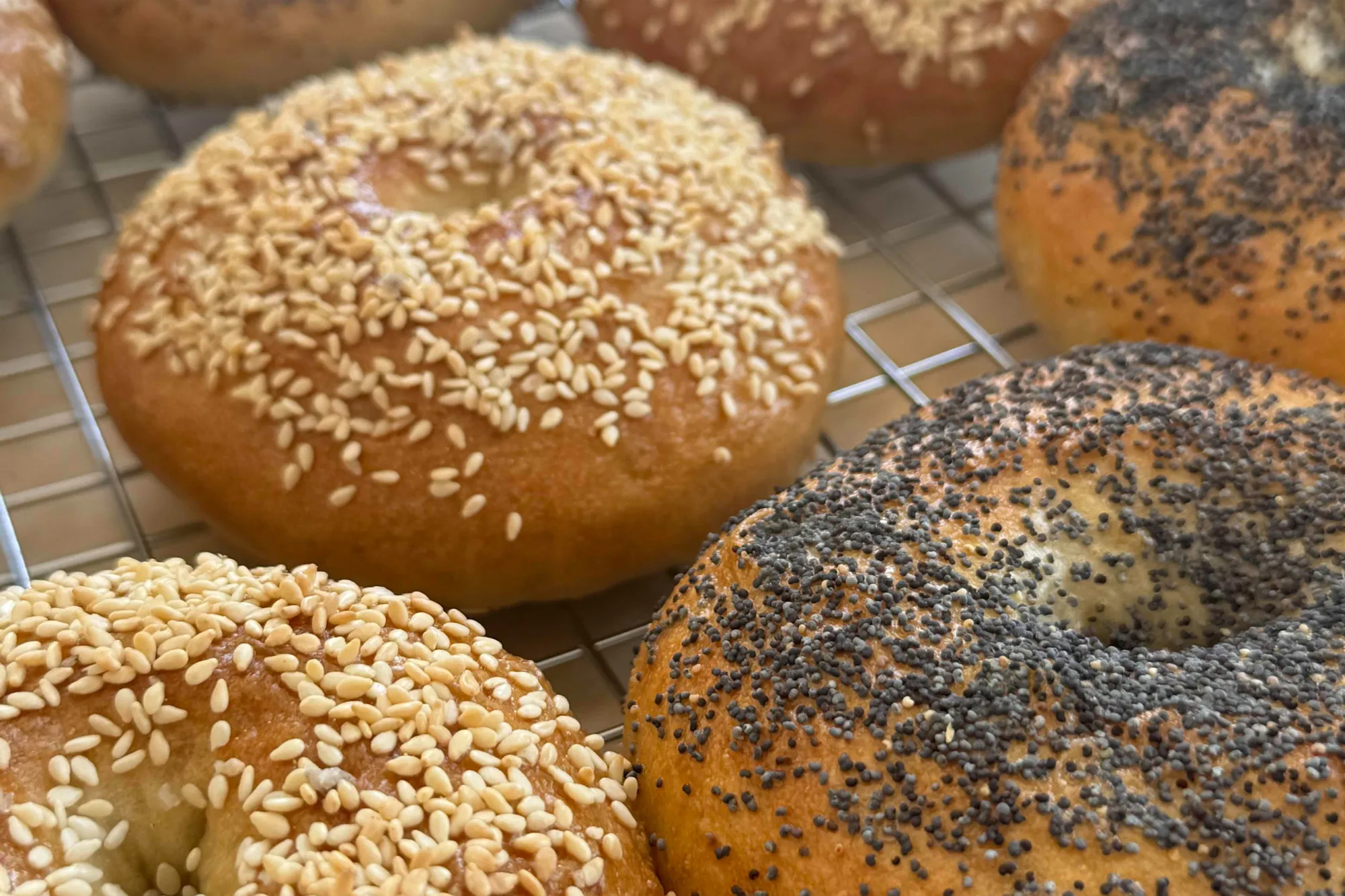
Bagels
- Makes
- 12 bagels, 130 grams each
- Active time
- About an hour
- Total time
- About 2.5 hours
- Level
- Medium
Ingredients
Dough
- 1 kg Flour, strong bread flour, see notes
- 550 g Water, cold
- 20 g White sugar
- 40 g Barley malt syrup, optional, instead of the sugar
- 8 g Instant dry yeast
- 25 g Salt
Boiling water
- 2000 g Water
- 42.5 g Date syrup, maple syrup or honey, or the same amount of barley malt syrup
- 1 tbsp Baking soda, optional
Toppings
- Sesame, poppy seeds, coarse salt, everything seasoning...
Method
Step 1 of 3Dough
- 1 kg Flour, strong bread flour, see notes
- 550 g Water, cold
- 20 g White sugar
- 40 g Barley malt syrup, optional, instead of the sugar
- 8 g Instant dry yeast
- 25 g Salt
Making yeast dough for the first time?
- Lukewarm liquids, not hot. About the temperature of a pleasant bath. Too much heat kills the yeast, and the dough won’t rise.
- Sticky dough is fine. Don’t rush to add flour: keep kneading, and the dough becomes smooth and stops sticking. Extra flour makes a dry, heavy bake.
- Knead until it passes the windowpane test. Stretch a small piece between your fingers: if it stretches into a thin, translucent film without tearing, the dough is ready.
- Go by the dough, not the clock. In a cold kitchen it takes longer. The dough is ready when it has doubled in size and a dent pressed with a finger springs back slowly.
- Shape gently, without rolling too hard or flouring the counter too much, so you don’t knock out all the air that has built up.
- In a stand mixer with the dough hook, knead all the ingredients except the salt for about 5-10 minutes, until the gluten develops.
- Add the salt toward the end of kneading and knead for about another minute.
- Stop the mixer and turn the dough out onto a work surface.
- Knead the dough a little more by hand and shape it into a ball.
- Put the ball of dough in a clean bowl and cover with plastic wrap.
- Let the dough rise for about 30-45 minutes, until it has grown by about half. Don't wait for it to double: an overproofed bagel comes out flat and wide.
Step 2 of 3Shaping
- After the first rise, divide the dough into 130-gram pieces and roll each one into a tight log.
- Cover the logs with a towel and let them rest for 5-10 minutes.
- Roll each log into a thick, short rope (a long, thin rope gives a wide, flat bagel), on an unfloured surface.
- Close into a ring: overlap the ends by about 3 cm and roll the seam against the surface with your palm until it's well sealed. The hole shrinks during boiling and baking, so leave it 2-3 times bigger than you want it in the end.
- Cut parchment paper into squares and set each bagel on its own square, so it's easy to move it into the pot later without knocking the air out of it.
- Let the bagels rise for another 15-30 minutes, then do the float test: drop one bagel into a bowl of water. If it floats within about 10 seconds, the bagels are ready. If it sinks, test again every 5-10 minutes. If it floats right away, they've overproofed, so boil them quickly.
Step 3 of 3Boiling and baking
Boiling water
- 2000 g Water
- 42.5 g Date syrup, maple syrup or honey, or the same amount of barley malt syrup
- 1 tbsp Baking soda, optional
Toppings
- Sesame, poppy seeds, coarse salt, everything seasoning...
- Heat the oven to 240°C.
- Bring a pot of water to a boil before the second rise is over, so the bagels don't have to wait.
- When the water boils, add the syrup and stir. If you're using baking soda, add it gradually, as it foams.
- Lower the heat a little to a gentle simmer (about 95°C).
- Gently lower the bagels one at a time (ideally no more than 2-3 together) into the boiling water, along with their parchment squares. The paper comes off on its own as they cook; fish it out of the water.
- Boil each bagel for 30-60 seconds, flip it and boil the other side for the same time.
- Drain well and set on a rack or paper towels for half a minute to a minute to get rid of the liquid. A wet bagel going into the oven comes out with a rubbery crust.
- If you're using toppings, add them now (for example, sprinkle with sesame).
- Bake the bagels for about 12 minutes (target internal temperature: 93°C). They won't necessarily brown. If the crust comes out soft or rubbery, bake them for another 2-4 minutes.
- Cool on a rack, uncovered.
Comments
No comments yet. Made it? Tell us how it went!