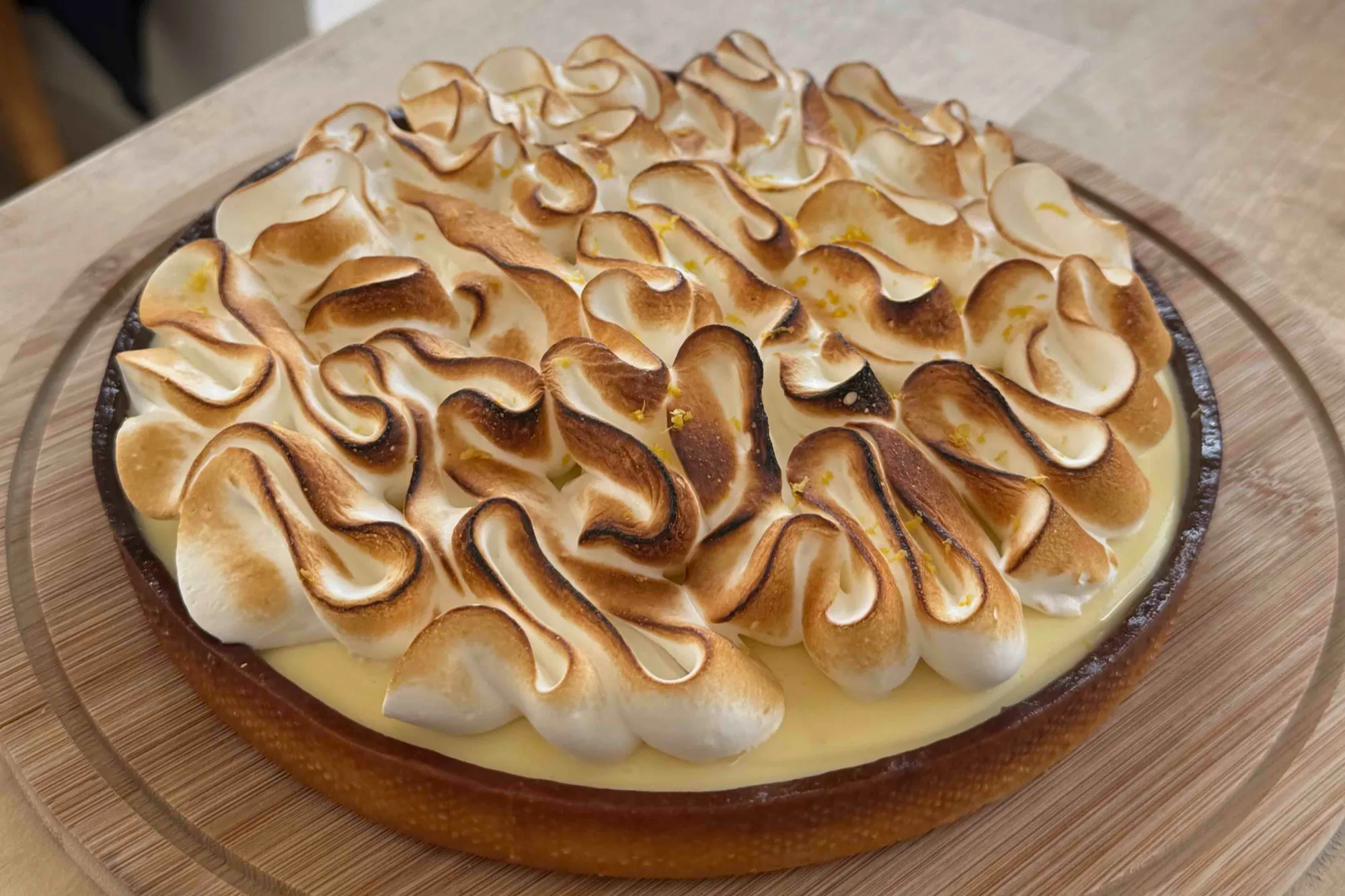
Lemon Tart
- Makes
- A 24 cm round tart
- Active time
- About 1.5 hours
- Total time
- About 6 hours
- Level
- Medium
Ingredients
Shortcrust tart shell
- 134 g Flour
- 48 g Powdered sugar
- 16 g Ground almonds
- 1 g Salt
- 64 g Butter, cold, cut into cubes
- 30 g (about ½) Egg
Lemon cream
- 220 g Eggs (about 4 large eggs)
- 80 g Sugar
- Zest of 2 lemons
- 90 g Lemon juice
- 150 g Butter, cut into cubes
- 1 g Gelatin
- 6 g Water, for the gelatin
Italian meringue
- 100 g (about 3½) Egg whites
- 35 g Water
- 200 g Sugar
Decoration
- Lemon zest
Method
Step 1 of 3Shortcrust tart shell
- 134 g Flour
- 48 g Powdered sugar
- 16 g Ground almonds
- 1 g Salt
- 64 g Butter, cold, cut into cubes
- 30 g (about ½) Egg
Making shortcrust for the first time?
- Everything cold. Butter straight from the fridge, cut into cubes. Butter that has softened gives a greasy dough that shrinks in the oven.
- Don’t knead. Pulse or rub in only until the mixture looks like wet sand, then bring it together into a dough in a few movements. Overworked dough comes out tough and shrinks.
- Chill before rolling, and roll between two sheets of parchment paper. That way you don’t need to add flour, and the dough doesn’t stick. Getting soft and tearing? Back in the fridge for 10 minutes.
- A crack or hole in the pan? Press on a scrap of leftover dough. It won’t show in the end.
- Freeze before baking, and bake until the dough is golden everywhere, including the bottom. A pale crust comes out soft, not crisp.
- In a food processor with the steel blade, combine the flour, powdered sugar, ground almonds, salt and cold cubed butter. Process on high speed until the mixture looks like crumbs.
- Add the egg and keep processing on low speed until you have an even dough.
- Turn the dough out onto a work surface and gently smear it across the surface for about a minute, until it comes together evenly.
- Gather the dough into a ball.
- Wrap the dough in plastic wrap and flatten it slightly into a disc.
- Chill the dough in the fridge for at least an hour.
- Roll out the chilled dough on lightly floured parchment paper to about 2 mm thick.
- Line a tart pan or ring with the dough, making sure to form a sharp right angle between the base and the sides.
- Prick the base of the tart and freeze it for an hour.
- Heat the oven to 170°C fan and blind-bake the tart shell fully, for about 20 minutes.
- Take the tart out of the oven when it is golden and let it cool completely at room temperature.
Step 2 of 3Lemon cream
- 220 g Eggs (about 4 large eggs)
- 80 g Sugar
- Zest of 2 lemons
- 90 g Lemon juice
- 150 g Butter, cut into cubes
- 1 g Gelatin
- 6 g Water, for the gelatin
First time with gelatin?
- Bloom it in cold water first, until the gelatin has absorbed all the water. Gelatin that goes into the cream dry makes lumps.
- Melt it with heat, not boiling. Add it to a hot mixture, or melt it for a few seconds in the microwave. Boiling weakens gelatin.
- A gelatin cream you fold whipped cream into has to be at room temperature: too warm, and the whipped cream melts. Too cold, and it starts to set and you get lumps.
- Gelatin needs time. A few hours in the fridge, preferably overnight, before slicing or unmolding.
- Mix the water and gelatin and place in the fridge for about 10 minutes, until the gelatin has absorbed all the water and there is no free water left.
- Meanwhile, make the cream: in a bowl, mix the eggs, sugar and lemon zest.
- Bring the lemon juice to a boil in a saucepan. As soon as it boils, turn off the heat and pour it into the bowl, stirring all the time.
- Return the mixture to the saucepan, set it over medium heat and stir constantly with a whisk.
- Bring the mixture to a light thickening (for the precise: 82-84°C) and turn off the heat.
- Transfer the mixture to a measuring jug or a tall, narrow container. Add all the butter at once and blend well with an immersion blender.
- Gently melt the gelatin in the microwave in bursts of about 5-10 seconds, just until it has all melted and no longer.
- Add the gelatin and blend into a smooth cream.
- For an extra-smooth cream: pass it through a fine sieve.
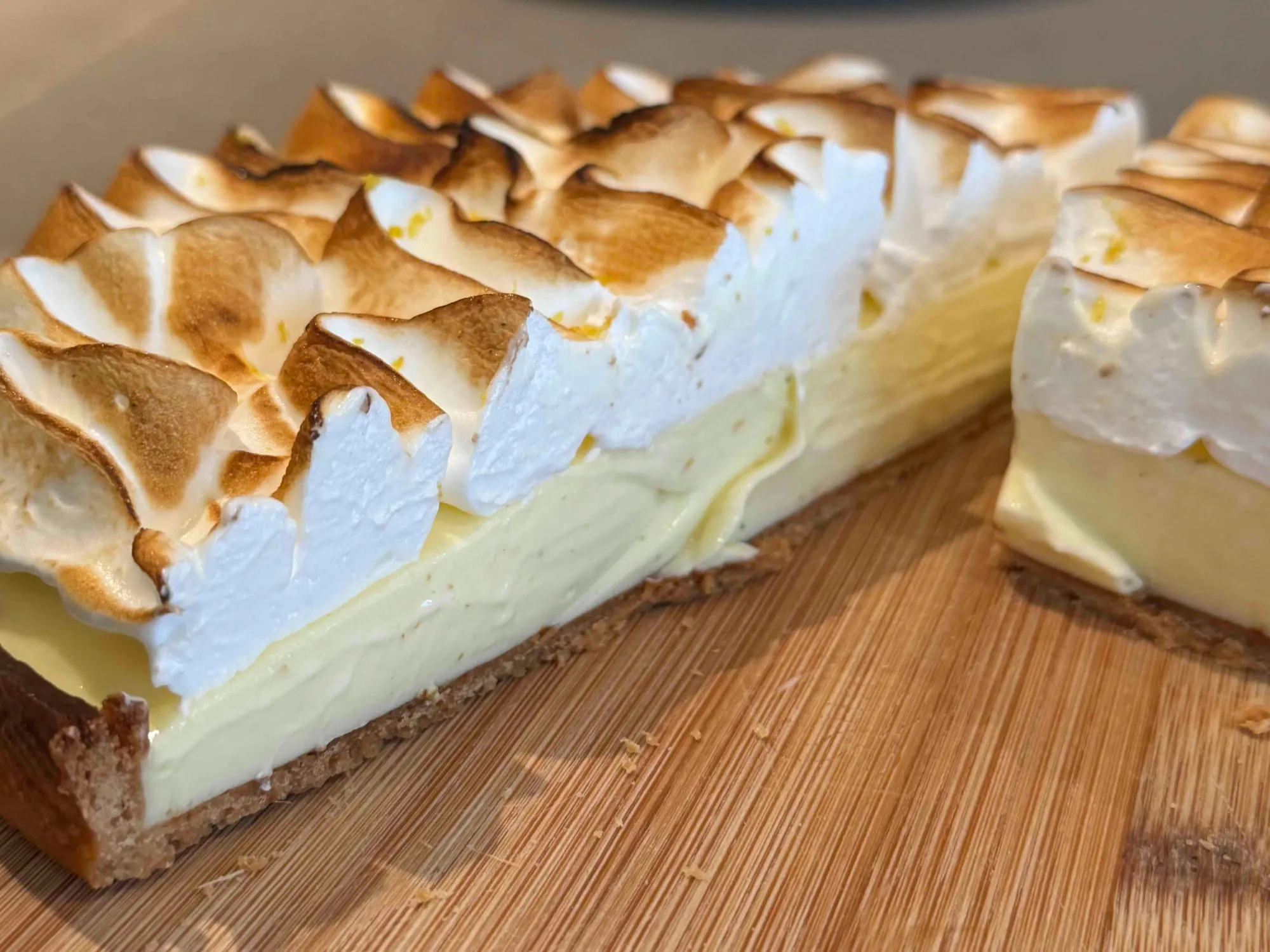
- Pour the cream into the tart shell and level it with an offset spatula or a spoon.
- Chill in the fridge for a few hours, preferably overnight.
Step 3 of 3Italian meringue
Italian meringue
- 100 g (about 3½) Egg whites
- 35 g Water
- 200 g Sugar
Decoration
- Lemon zest
Making Italian meringue for the first time?
- A thermometer is a must. The syrup has to reach exactly the temperature in the recipe, and you can’t guess it by eye.
- Timing: start whipping the whites when the syrup is nearing temperature (the recipe says when), so the soft foam is ready just as the syrup is. A completely clean bowl, without a drop of yolk.
- Don’t stir the syrup while it cooks, or it will crystallize.
- Pour in a thin stream down the side of the bowl, between the whisk and the side, not onto the whisk: whatever hits it splatters and hardens on the sides. Careful, syrup at 118°C causes serious burns.
- Keep whipping until the bowl no longer feels warm, a good few minutes. The meringue is ready when it’s glossy, thick and holds a stiff peak.
- Shortly before serving, make the Italian meringue. Heat the sugar and water in a saucepan over medium heat.
- While the sugar and water heat, put the egg whites in a clean stand mixer bowl fitted with the whisk.
- When the syrup reaches about 105°C, start whipping the whites on medium speed.
- When the syrup reaches 117°C, turn off the heat.
- Carefully drizzle the boiling syrup into the mixer bowl, aiming between the whisk and the side of the bowl.
- Once all the syrup is in, turn the mixer up to high speed.
- Stop whipping when the bowl no longer feels warm to the touch, after about 10 minutes.
- Transfer the meringue to a piping bag with the tip of your choice (I used a Saint-Honoré tip) and pipe right away.
- Carefully torch the meringue with a blowtorch.
- Decorate with lemon zest and serve.
Comments
No comments yet. Made it? Tell us how it went!