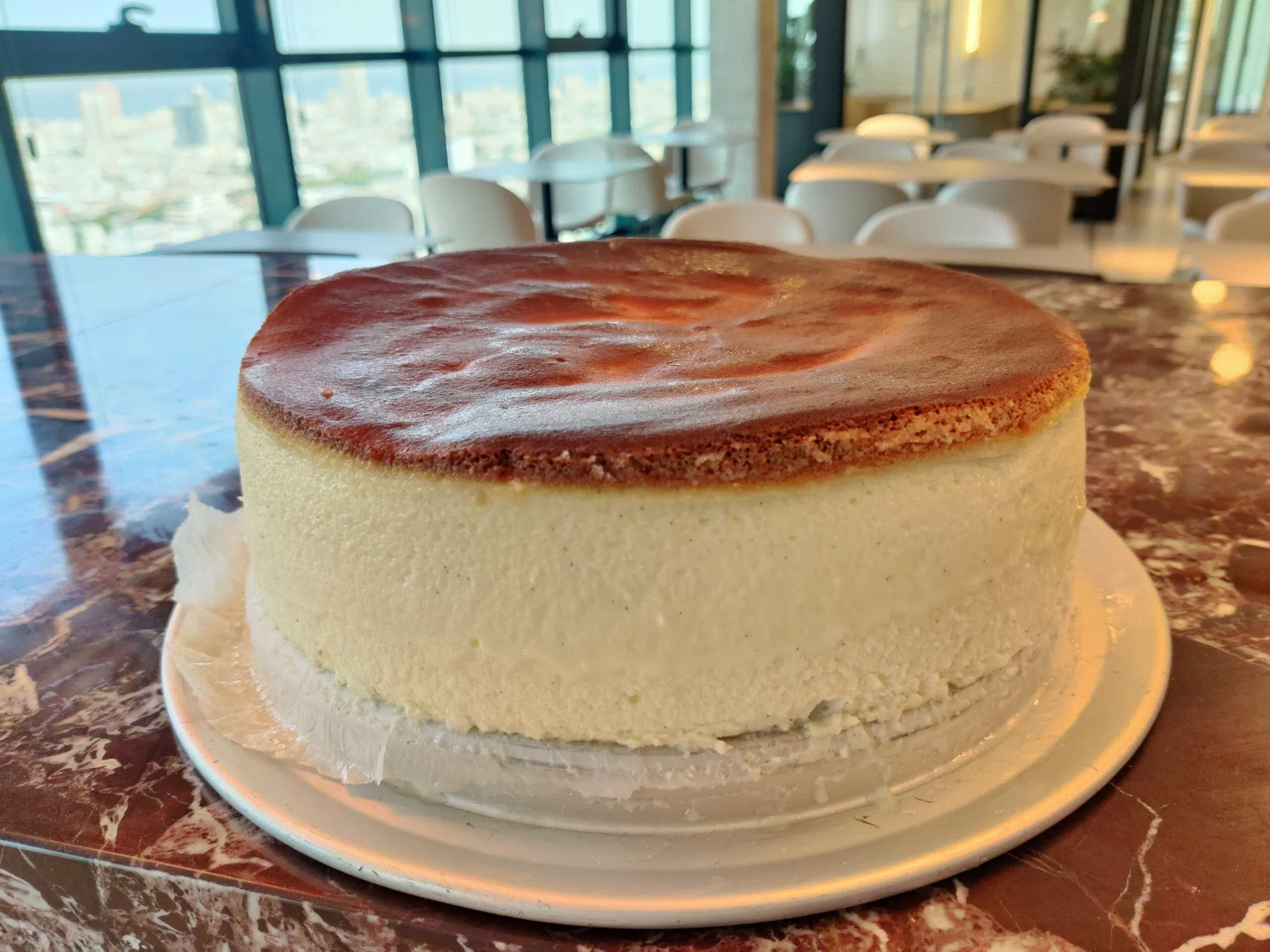
Baked Cheesecake
- Makes
- A 24 cm round tin, 8 cm high
- Active time
- About 1.5 hours
- Total time
- About 12 hours
- Level
- Medium
Ingredients
Shortcrust base
- 150 g Flour
- 100 g Butter, cold, cut into cubes
- 40 g Powdered sugar
- A pinch of salt
- 1 Egg yolk
Cheesecake
- 434 g Cream cheese, at least 25% fat, at room temperature
- 868 g Quark, 1%-9%
- 237 g Sour cream
- 43 g Tapioca starch or cornstarch
- 75 g Instant vanilla pudding mix
- 180 g (about 10) Egg yolks
- 100 g Sugar
- 1 Vanilla bean
Meringue for the cake
- 180 g (about 6) Egg whites, at room temperature
- 165 g Sugar
Method
Step 1 of 2Shortcrust base
- 150 g Flour
- 100 g Butter, cold, cut into cubes
- 40 g Powdered sugar
- A pinch of salt
- 1 Egg yolk
Making shortcrust for the first time?
- Everything cold. Butter straight from the fridge, cut into cubes. Butter that has softened gives a greasy dough that shrinks in the oven.
- Don’t knead. Pulse or rub in only until the mixture looks like wet sand, then bring it together into a dough in a few movements. Overworked dough comes out tough and shrinks.
- Chill before rolling, and roll between two sheets of parchment paper. That way you don’t need to add flour, and the dough doesn’t stick. Getting soft and tearing? Back in the fridge for 10 minutes.
- A crack or hole in the pan? Press on a scrap of leftover dough. It won’t show in the end.
- Freeze before baking, and bake until the dough is golden everywhere, including the bottom. A pale crust comes out soft, not crisp.
- Put the flour, powdered sugar, salt and cold cubed butter in a food processor with the steel blade. Process on high speed until the mixture is crumbly.
- Add the egg yolk and keep processing on low speed until the dough is uniform.
- If the dough doesn't come together, add a little cold water and keep processing until it does.
- Wrap the dough in plastic wrap and flatten it slightly into a disc.
- Chill the dough in the fridge for at least an hour.
- Roll out the chilled dough on lightly floured parchment paper to about 3 mm thick.
- Cut out a 24 cm disc. It will shrink by 1-2 cm as it bakes and fit inside the cake tin.
- Bake the disc all the way through in an oven preheated to 180°C, until it's golden all over.
- Let it cool completely at room temperature.
Step 2 of 2Cheesecake
Cheesecake
- 434 g Cream cheese, at least 25% fat, at room temperature
- 868 g Quark, 1%-9%
- 237 g Sour cream
- 43 g Tapioca starch or cornstarch
- 75 g Instant vanilla pudding mix
- 180 g (about 10) Egg yolks
- 100 g Sugar
- 1 Vanilla bean
Meringue for the cake
- 180 g (about 6) Egg whites, at room temperature
- 165 g Sugar
Making a cheesecake for the first time?
- Everything at room temperature, cheese, eggs and cream. Cold cheese leaves lumps, and then you overmix to get rid of them.
- Mix the cheese filling slowly, don’t whip it. Low speed, and the eggs one at a time just until absorbed. Air in the batter puffs up in the oven, and then the cake sinks and cracks.
- Take it out while the center still jiggles when you shake the pan. The cake keeps setting as it cools.
- Patience at the end. Cool at room temperature, then overnight in the fridge. Only after chilling does it slice cleanly and get the right texture.
Whipping egg whites for the first time?
- A completely clean bowl and whisk, without a drop of fat. Even a little yolk in the whites, and they won’t whip.
- Room-temperature whites whip faster and to a bigger volume.
- Medium speed, not maximum. Foam built slowly is more stable, with small, even bubbles.
- Know your peaks: a soft peak flops over when you lift the whisk, a stiff peak stands up. Overwhipped whites look grainy and dry, and can’t be saved.
- Fold, don’t stir, as soon as the foam is ready: with a spatula or whisk, in wide strokes from the bottom, so you don’t break the bubbles.
- Use a cake ring or a springform pan for this recipe. Line the base with parchment paper, with aluminum foil under it and plastic wrap under that, much like in the attached video, only with plastic wrap underneath. Make sure the ring or pan is wrapped in plastic wrap all around, right up to the top, since it goes into a water bath in the oven and you don't want any water getting in.
- Heat the oven to 230°C. Butter the tin well, without missing a spot. Then sprinkle sugar over the buttered sides, making sure the sugar covers them completely.
- In a bowl, mix the cheeses with the tapioca starch or cornstarch and the instant vanilla pudding mix, until the mixture is smooth with no lumps at all.
- Add the yolks, the vanilla and the sugar (the smaller amount of sugar, listed under "Cheesecake" in the ingredients).
- Make the meringue: put the egg whites in a perfectly clean mixer bowl and whisk on medium speed for about two minutes, until a light white foam forms. Gradually add the sugar while whisking on medium speed, until you get a stable, flexible meringue (soft peaks), not a stiff one.
- Fold the meringue into the cheese and yolk mixture in two additions. Fold with a whisk until almost fully combined, and finish folding with a spatula. Mix until fully combined and no more, since overmixing can knock the air out of the batter.
- Place the baked shortcrust disc in the center of the cake tin. Pour the batter over it and level it.
- Set the cake tin inside the deepest roasting pan you have and fill the pan with lukewarm water (you can fill it once the cake is already in the oven). The water should come at least a third of the way up the cake.
- Bake in an oven preheated to 230°C, without fan, for about 15-20 minutes, or until the top has a golden-brown crust.
- Lower the oven to 160°C and open the oven door for a few minutes to let it cool down; the cake can stay inside. Keep baking for about 40-60 minutes more, or until the cake feels fairly set. When you tap the top lightly, the crust should be completely firm and the cake should wobble slightly, but not too much.
- When it's done, take the cake out of the oven and out of the water bath. Once it has cooled completely at room temperature, refrigerate it for a few hours, preferably overnight.
Comments
No comments yet. Made it? Tell us how it went!